the bio.t METHOD
Our bio.t™ METHOD is a playbook that helps you through the process of re/designing your strategy, innovations and business model. Using Nature’s design thinking playbook.
Nature’s design thinking playbook works differently from human centered design. It gives you very different ways to diagnose, discover, design and deploy value potential, for unlocking your disruptive power. There are three things that set the bio.t™ METHOD apart.
-
Most strategy and innovation frameworks ignore the science of life. Promoting "faster, newer, cheaper" games, that chase first-player advantage in a zero-sum, agile (and often aimless) world.
As global markets price in the materiality of the living world (‘natural capital’ is 3x the CO2 climate bubble), you run the risk of not only wasting time and money, you limit your potential.
The living world is where the biggest disruptive growth opportunities are, where the coolest innovation is happening, where most of the investment world is heading, and where incredible profit potential lives.
Leveraging patterns of biological value in the living world doesn’t just reduce your risk, it gives you a platform to build real strategic advantage, open up new markets and unlock multiple revenue streams.
You don’t have to be in biotech or have any science background. Nature’s bio-patterns can be applied by anyone, across any industry, or business unit division.
-
The bio.t™ METHOD plays in the design thinking intersection of Biomimicry, Living Systems , and Living Relational Ethics. All seamlessly synthesized.
This is based on Melissa’s analysis and curation of 100 years of disruptive regenerative, living-system principles of how Nature designs, and her US MSc in Biomimicry. Calibrated specifically for business strategy and innovation.
Together they help you sense, seize and scale value potential. For you to directly apply to re/designing your business, and re/skilling your leadership capabilities.
Melissa’s done the deep thinking and heavy lifting so you don’t have to.
-
Melissa is a practitioner, trained as a system-design strategist, who’s played hands-on, across multiple industries and businesses, to unlock value potential, from in the arena. She’s not an academic, talking head or reinvented ad-man.
Which means you get what works real life, real-time - the steps to follow, the questions to ask, and the models to use (and to avoid) from Melissa’s 25 years of transforming businesses (global corporates to start ups and NGOs), 15 years on the disruptive regenerative "bright" side, 10 years teaching and training exec teams and entrepreneurs, and 5 years deep diving into Nature’s design thinking playbook.
Made of 2 parts
THE PROCESS
The bio.t™ canvas journeys you through the process of re/designing your business.
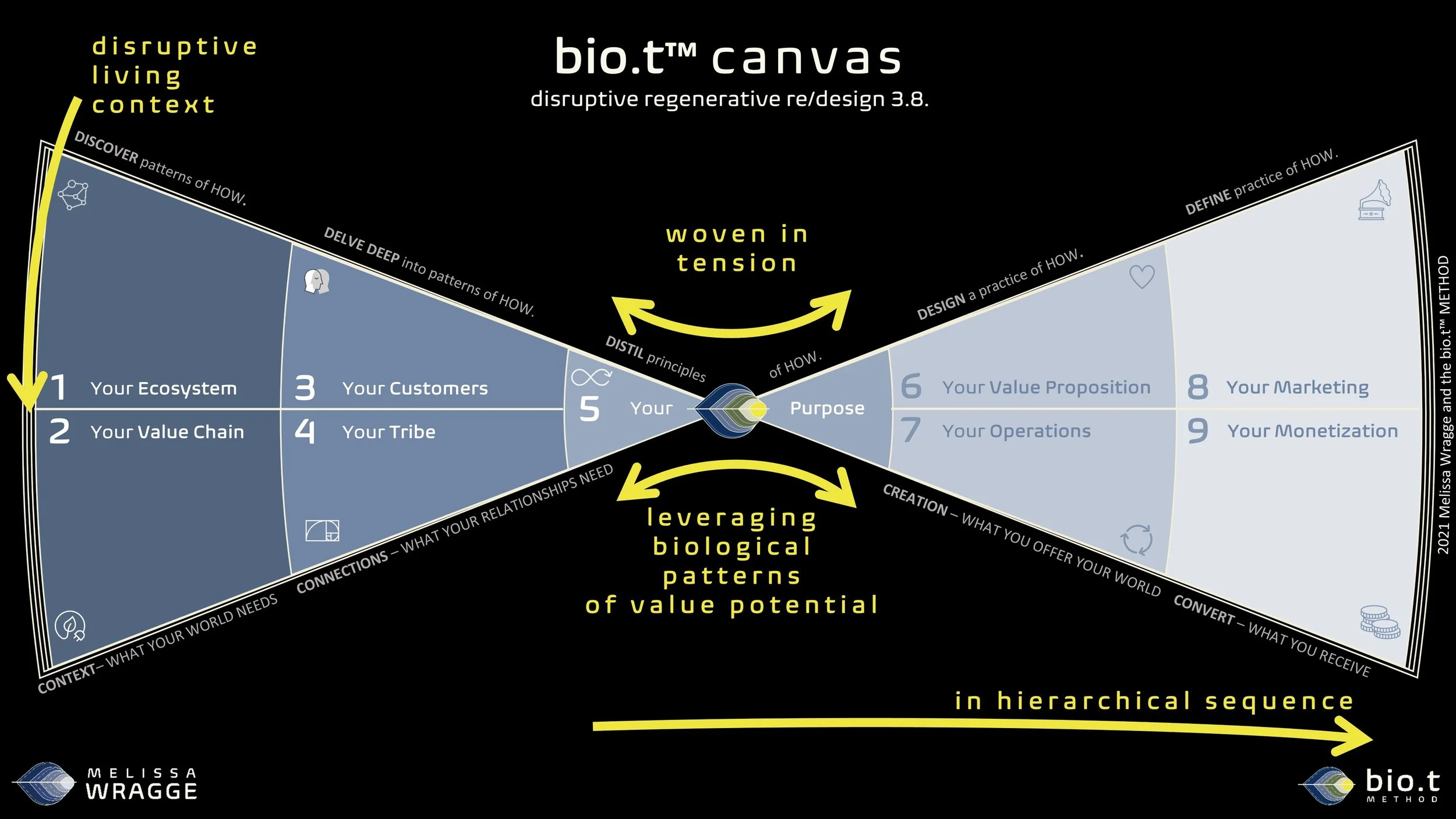
Most people struggle with process. Especially when the tools we’re taught to use make the problem worse. The bio.t canvas looks different than other canvases because it is. It’s designed based on how Nature works.
(1) It is intentionally sequenced in hierarchical order, based on Nature’s disruptive adaptive “fitness from fittedness”. (2) It starts first with rooting yourself in the context of the living world and the lived experience of relationships to build your adaptive power. (3) Each part, in turn, explores and leverages deep biological patterns of unlocking value potential. Based on the blueprints and hardcoding that have underwritten life on Earth for the last 3.8 billion years. (4) Lastly, each part works to re/connect you, in relationship (to time, place, self, others etc). We lean into the tension - to build, what we call, your BQ™; your biological quotient. It’s the meta key.
As global markets disrupt to price in Nature’s living world, this process helps you make better strategic decisions on where to play, how to innovate, where to invest your time, tech and money, and how to build your complex adaptive resilience. And each part comes with a support toolkit, to make things easy.
THE PRINCIPLES
The bio.t™ compass is a leadership capability building framework. It curates and synthesizes biomimicry, living ecology, living ethics, living systems as design thinking principles.
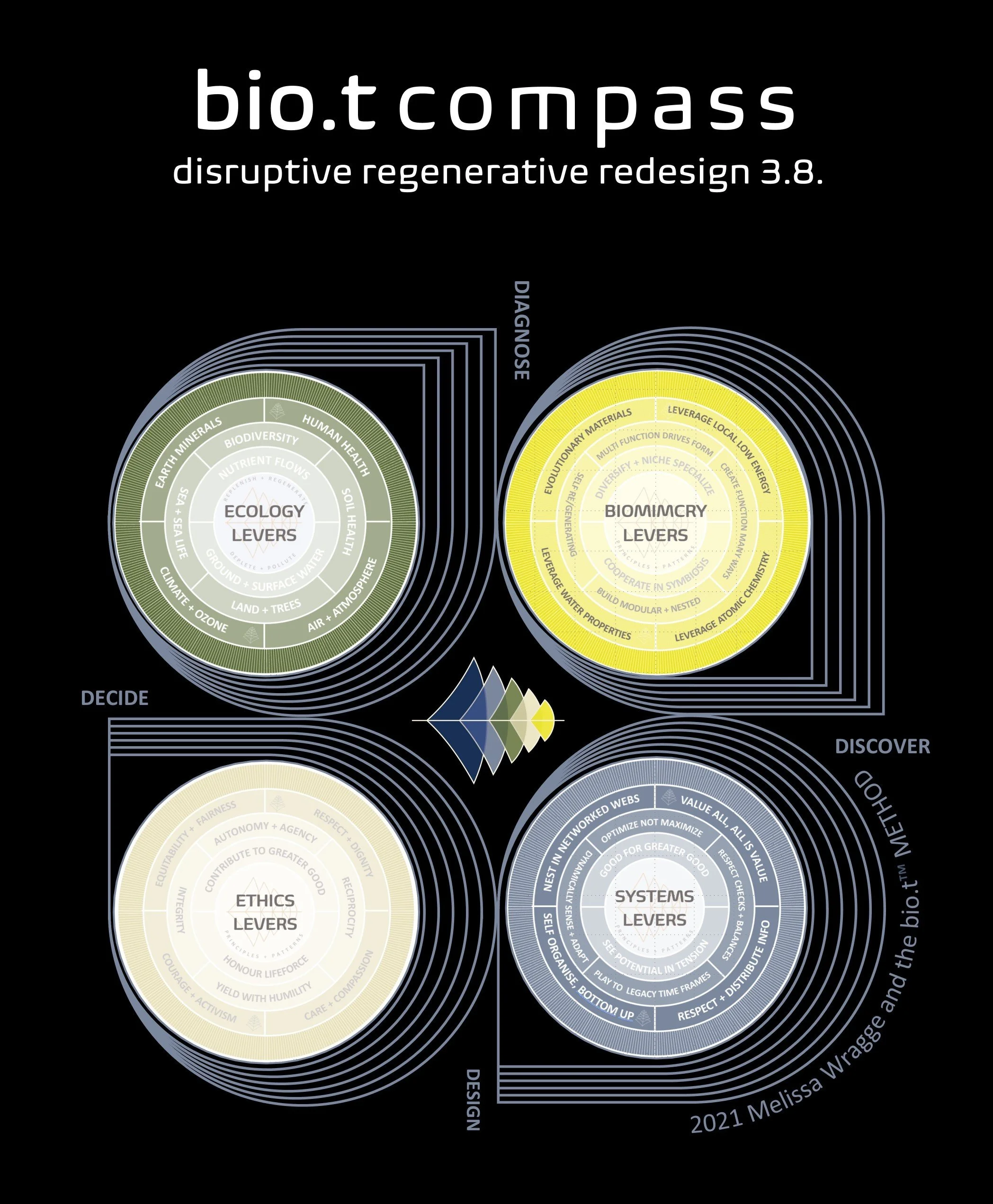
NOT virtue signalling principles. Principles that reflect the deep patterns of how life functions, in living systems. They function as strategic levers of future value creation (the foundation of design thinking). They give you the thinking and practice tools you need to unlock value potential.
Nature’s design thinking playbook works in the intersection of these four axes. They play at the highest order of performance, efficiency, scalability, and adaptive resilience. They’re built on Melissa’s deep analysis of 100 years of regenerative disruptive living-system research, and the four axes from which Nature unlocks value potential.
Upskilling in these capabilities requires a re/connection to being in relationship. This builds your BQ™; your biological quotient, the meta key to level up your strategic practice.
why Nature’s design thinking playbook?
Because as global markets price in the materiality of the living world, there isn’t just huge risk. There’s huge opportunity. If you uses Nature’s design thinking playbook, you get on the inside track of solving not one, but 3 converging meta problems.
-
Most organizations are playing a Nature game driven by TNFD and SBTN governance disclosures. Focused on footprints and emissions, with a compliance cost mindset. But this misses the point.
The ‘natural capital’ bubble is 3x LARGER than the CO2 bubble (Stuchtey et al 2016). If you haven’t connected your business model and strategy to the science of life, then the disruptive impact on your balance sheets and P&Ls is big.
But the BIGGER RISK is you miss seeing the opportunity. The emerging circular bioeconomy is estimated to be worth US$7.6 trillion, with growth of 11.7% (1) and worth US$30 trillion by 2050 (2), a third of global GDP, while positively impacting 9 different Sustainable Development Goals (3).
The European Union’s circular bioeconomy is already US$2.3 trillion, supporting 17 million jobs (4). Other countries, like Aotearoa, New Zealand, with 80% of trade exports reliant on land-based products (5) are only nascent in the transition.
The speed with which businesses adapt and transition to the circular bioeconomy and realise the significant twofold benefits of economic growth and risk resilience, is redefining the playing field for markets and global geopolitics.
—-
1.HTF Market Intelligence. October 2025. Global circular bioeconomy projects market – global outlook 2020-2033. https://www.htfmarketinsights.com/report/4383907-circular-bioeconomy-projects-market
2.Nature Finance. 2024. The Global Bioeconomy. https://www.naturefinance.net/wp-content/uploads/2024/05/ENG-TheGlobalBioeconomy_FINAL.pdf
3.Taron, A. and Gebrezgabher, S., 2024. Circular bioeconomy: A pathway to sustainable development in an age of global crisis. https://doi.org/10.1108/978-1-83753-586-620241007
4.European Commission. 2024. The sustainable and circular bioeconomy in the EU. https://unece.org/sites/default/files/2024-03/S2d_2_The%20sustainable%20and%20circular%20bioeconomy%20in%20the%20EU.pdf .
5.Scion, the New Zealand Bioeconomy Science Institute, 2025. Growing New Zealand’s bioeconomy. https://www.scionresearch.com/about-us/the-forest-industry-and-bioeconomy/the-circular-bioeconomy#:~:text=A%20just%20transition:%20Moving%20from,Stora%20Enso
-
Business model innovation (BMI), the process of transforming or redesigning a business model is a compounding problem for bio-circular futures; it sits on top of an existing BMI problem. When it comes to transforming any kind of business model, there are a few big elephants in the room:
ELEPHANT #1 - BMI SUCCESS RATES
70% of business transformations fail to improve performance over time (McKinsey & Co 2021).
88% of transformation innovations fail at achieving their original goal (Bains & Co 2024).
97% of business leaders are not ready to deliver strategic innovation (Boston Consulting Group 2024).
What’s more, those 30% of businesses that do succeed, still leave 1/3 of their potential value untapped (McKinsey & Co 2022).
And the 70% that don’t? Most end in various forms of theatre - restructures, hackathons and process rewrites (5). Digital transformations are now estimated to cost global business an un-fathomable $2.3 trillion dollars in wasted time and effort (6).
ELEPHANT #2 - BMI CAPABILITIES
Behind these statistics sits a lack of critical thinking capabilities:
McKinsey & Co (2022) identify the #1 root cause as a lack of fact-based clarity when defining strategic goals and purpose (7). In other words, value gets lost in the thinking.
Bains & Co (2024) identify the #1 root cause as a lack of dedicated people with strategic thinking capabilities (8).
World Economic Forum (2025) identify the #1 barrier to business transformation as a leadership skills gap in resilience, adaptive agility, and complex systems thinking (9).
ELEPHANT #3 - BMI TOOLS
And behind these capability gaps sits a lack of thinking and practice tools. Research continues to reveal that, despite the many business model canvases that exist, it’s (i) the process of BMI that is the primary challenge in sensing and transforming value (Foss and Saebi 2017, Pieroni et al 2019), with (ii) a lack of contextual ecosystem framing (Zott et al 2024), and (iii) a gap in synthesizing the required capabilities needed to undertake a BMI process (Buruleaunu et al 2025).
In short, there’s a big gap. Plugging this gap is where we play.
We work with you in three, interdependent, ways:
Strategic transformation journey,
Capability building, and
Diagnostic measurement.
In this way, you’re guided step by step through the BMI process from contextual discovery and sense-making through to strategic decision making through to design of your strategy, innovations and business model. No matter where your starting point is.
We give you the thinking models, tech tools and practice steps. And we showcase what’s possible.
WHY WE LOVE THIS GAME
Because the rewards for you are in multiples - 1. Multiple new revenue streams, 2. Multiple new market creating, 3. Demand-led B2B and B2C growth, 4. Scalable growth, 5. De-risking, 6. Lower costs, 7. Capital flows, 8. More profit, and 9. At the highest order of sustainability.
Because it strengthens both your decision making (THINK) and executional performance (DO) - for your ongoing adaptive resilience
Because it applies to any business, across any sector, doing strategy or innovation (not just the biotech disruptors).
Because you don’t have to be a biologist, or even a design thinker, to do this. It only requires an entrepreneurial mindset.
And because frankly, it’s way more fun. It’s why we call it the bright side.
——
(1) McKinsey & Company. December 2021. Losing from day one: Why even successful transformations fall short. https://www.mckinsey.com/capabilities/people-and-organizational-performance/our-insights/successful-transformations
(2) Bains & Company. April 2024. The Three Common Transformation Talent Mistakes and How to Avoid Them https://www.bain.com/insights/the-three-common-transformation-talent-mistakes-and-how-to-avoid-them/
(3) Boston Consulting Group. June 2024. Innovation Systems Need a Reboot. https://www.bcg.com/publications/2024/innovation-systems-need-a-reboot
(4) McKinsey & Company. February 2022. The science behind transformations: Protecting value from day one. https://www.mckinsey.com/capabilities/people-and-organizational-performance/our-insights/the-organization-blog/the-science-behind-transformations-protecting-value-from-day-one
(5) Harkin, B. 2024. $2.3trillion Wasted Globally in Failed Digital Transformation Programs https://newsroom.taylorandfrancisgroup.com/costly-business-overhauls-are-not-needed-to-embrace-new-digital-technologies-according-to-specialist/
(6) Blank, S. (2019). Why companies do “innovation theater” instead of actual innovation. Harvard Business Review, 7, 2-5. ttps://steveblank.com/category/harvard-business-review/
(7) McKinsey & Company February 2022. The science behind transformations: Protecting value from day one. https://www.mckinsey.com/capabilities/people-and-organizational-performance/our-insights/the-organization-blog/the-science-behind-transformations-protecting-value-from-day-one
(8) Boston Consulting Group. June 2024. Innovation Systems Need a Reboot. https://www.bcg.com/publications/2024/innovation-systems-need-a-reboot
(9) World Economic Forum 2026. Next Generation Leadership for a World in Transformation: Driving Dialogue and Action https://reports.weforum.org/docs/GFC_White_Paper_on_New_Leadership_Models_for_Future_Generations_2026.pdf
(10) Foss, N.J. and Saebi, T., 2017. Fifteen years of research on business model innovation: how far have we come, and where should we go?. Journal of management, 43(1), pp.200-227. https://doi.org/10.1177/0149206316675927
(11) Pieroni MPP, McAloone TC, Pigosso DCA. 2019. Business model innovation for circular economy and sustainability: A review of approaches, Journal of Cleaner Production, Volume 215, Pages 198-216, ISSN 0959-6526, https://doi.org/10.1016/j.jclepro.2019.01.036.
(12) Zott, C., Amit, R., Giesen, E. 2024. Business Model Innovation Capability: A Game Changer for Sustaining a Firm’s Edge. In: Aagaard, A. (eds) Business Model Innovation. Palgrave Macmillan, Cham. https://doi.org/10.1007/978-3-031-57511-2_2
(13) Buruleanu, C. L., Chléirigh, L. N., Bhaird, M. N. a., Curran, T. P., Reinmuth, E., & Bîzoi, M. 2025. Weaving Knowledge, Innovation, and Learning: A Transdisciplinary Pathway to Circular Bioeconomy Through BioBeo. Sustainability, 17(14), 6541. https://doi.org/10.3390/su17146541
-
How you think about value is at the core of BMI, design thinking, and dynamic capabilities. You can think of them like 3 circles in a Venn diagram:
Business model innovation is based on how well you create, deliver, and capture value
Dynamic capabilities are based on how well you sense, seize, and transform value
Design thinking is based on how well you discover and design value
All three, when done well, identify not just value, but value potential, and value risk.
THE BIO CIRCULAR CHALLENGE
The circular bioeconomy adds a topspin to value thinking, because it not only requires a reshaping of consumer behaviours, but a reshaping of incumbent value chains and market ecosystems as well.
This requires you to push past the definitional boundaries of value that make up the three value pillars of a business model. In practice, it add a whole new dimension to the BMI process:
To see the flow of value, and the value of flow across open networked systems.
To see and transform emergent potential value of biomass waste streams.
To trade, transact and broker new reciprocal value exchanges in symbiotic win : win relationships, and co-create emergent value, with new business models
To contribute and gift value that enhances the interdependent economic ecosystem as a whole.
THE NATURE ADVANTAGE
This requires a way of thinking, an intelligence, that is (i) contextual, (ii) relational and (iii) transformational.
This is the reason why we look to Nature.
As beyond-human intelligence that’s not artificial, but evolutionary. With 3.8 billion years of living, adaptive R&D, and hardcoded algorithms resilient enough to underwrite the very foundations of life.
Right now cutting-edge businesses are re/designing anything from products, services and platforms to business models, value chains and operations - even ways of working as high performing teams.
They’re transforming themselves, building adaptive resilience, and disrupting the shape of global markets, global industries, and the rules of the global economy.
WEF estimates biomimicry could create US$10 trillion in GDP growth and 395 million new jobs by 2030 (1).
We think this undersells it. Research show there is a 88%+ innovation gap between how biology designs and how humans design (Vincent and Mann 2002).
Our own research shows Nature has evolved clear strategies to work dynamically across business model value axes, that can be cleanly and easily applied to business models, and the process of BMI. In the flow, exchange and transformation of value potential. In the creation, delivery and capture of value. In the sensing, seizing and leveraging of value.
We see ourselves only at the beginning of our disruptive evolutionary journey. Our bio.t METHOD gives you the levers to unlock yours.
Life is rich.
——-
* this analysis of value is based on a literary review of 78 well cited papers in business journals, too exhaustive to list here. Melissa is currently working on a white paper.
(1) World Economic Forum, July 2020. 395 Million New Jobs by 2030 if Businesses Prioritize Nature. https://www.weforum.org/press/2020/07/395-million-new-jobs-by-2030-if-businesses-prioritize-nature-says-world-economic-forum/
(2) Vincent J., Mann, D. 2002. Systematic technology transfer from biology to engineering. Philosophical transactions. Series A, Mathematical, physical, and engineering sciences. Volume 360, Pages 159-73, https://doi.org/10.1098/rsta.2001.0923
-
The t stands for Tensegrity. We originally called it the Tensegrity Method - but turns out, that was a bit of a mouthful!
Tensegrity is all about transformation - from leaning into tension. Tension is transformative. This is our adaptive flex; our adaptive opportunity.
Tensegrity is a design principle coined by Buckminster Fuller in reference to the tensional integrity of systems. The strongest systems only work when all parts are held in tension.
Nature favours tensegrity structures the most - from the structure of our DNA and cells, to the process of photosynthesis, to the shape of our our skeletal, muscular and myofascia systems, to the resilience of spider webs, birds’ nests and trees.
Tensegrity structures are the most effective, use the least materials and energy, and unleash the greatest transformative potential. Which directly relates to business in terms of performance, efficiency, growth scalability and disruptive power.
When we lean into the transformative power of tension, we unlock our disruption potential.
Which means we have to re/connect to be in better relationship. With life.