transforming business to disrupt. for bio circular futures
using
Nature’s
design thinking playbook
biomimicry . living systems . relationality
ADAPT . TRANSFORM . DISRUPT .
We specialise in helping exec teams and entrepreneurs, in the bio circular economy, through the process of business model innovation. Bridging entrepreneurial thinking with living biotech science.
we believe strategy connected to the science of life unlocks unparalleled growth opportunity. We believe innovation that leverages Nature’s 3.8 billion years of R&D is the key. We believe the blueprint for market leadership lies with living intelligence. We help you rethink what’s possible.
life is rich.

$7.6t
value of circular bioeconomy, with 11.7% growth, positively impacting 9 SDGs (HTF 2025, Taron et al 2024).

70%
of business transformations fail to lift performance (McKinsey & Co 2021)

97%
of business leaders are ill equipped to undertake strategic transformation and innovation (BCG 2024)

#1
barrier to transformation is a leadership skills gap in adaptive agility, and complex systems thinking (WEF 2025)
the 3 problems
we solve
-
The emerging circular bioeconomy is estimated to be worth US$7.6 trillion, with growth of 11.7% (1) and worth 1/3 of global GDP by 2050 (2), while positively impacting 9 different Sustainable Development Goals (3).
The European Union’s circular bioeconomy is already US$2.3 trillion, supporting 17 million jobs (4). Yet other countries, like Aotearoa, New Zealand, with 80% of trade exports reliant on land-based products (5) are only beginning.
How quickly businesses adapt will reshape global markets and geopolitics. But the process of transforming business models for bio-circular futures, called Business model innovation (BMI), is a compounding problem; it sits on top of a few, existing, unsolved, elephant-sized BMI problems.
ELEPHANT #1 - BMI FAILURE RATES
1. 70% of business transformations fail to improve performance over time (McKinsey & Co 2021).
2. 88% of transformation innovations fail at achieving their original goal (Bains & Co 2024).
3. 97% of business leaders are not ready to deliver strategic innovation (Boston Consulting Group 2024).
4. What’s more, those 30% of businesses that do succeed, still leave 1/3 of their potential value untapped (McKinsey & Co 2022).
And those that fail? Most end in various forms of theatre - restructures, hackathons and process rewrites (10). Digital transformations are now estimated to cost global business an un-fathomable $2.3 trillion dollars in wasted time and effort (11).
ELEPHANT #2 - BMI CAPABILITY GAPS
Behind these statistics sits a lack of critical thinking leadership capabilities:
1. McKinsey & Co (2022) identify the #1 root cause as a lack of fact-based clarity when defining strategic goals and purpose (12). In other words, value gets lost in the thinking.
2. Bains & Co (2024) identify the #1 root cause as a lack of dedicated people with strategic thinking capabilities (13).
3. World Economic Forum (2025) identify the #1 barrier to business transformation as a leadership skills gap in resilience, adaptive agility, and complex systems thinking (14).
ELEPHANT #3 - BMI BROKEN TOOLS
And behind these capability gaps sits dysfunctional thinking and practice tools. Research continues to reveal that, despite the many business model canvases that exist, frameworks fail to address the primary challenge of sensing and transforming value (Foss and Saebi 2017, Pieroni et al 2019), with (ii) a lack of contextual ecosystem framing (Zott et al 2024), and (iii) a gap in synthesizing the required capabilities needed to undertake the stepwise process of BMI (Buruleaunu et al 2025).
IN SHORT
THE BIG GAP : broken tools => stale capabilities => BMI failure. Plugging this gap is where Melissa plays. getting the right thinking tools, building the right capabilities, sequencing the journey right, showcasing what’s possible. So you can expand your contextual sense-making, and unlock your strategic potential.
The key is how you think about value…
——
1) HTF Market Intelligence. October 2025. Global circular bioeconomy projects market – global outlook 2020-2033. https://www.htfmarketinsights.com/report/4383907-circular-bioeconomy-projects-market
2) Nature Finance. 2024. The Global Bioeconomy. https://www.naturefinance.net/wp-content/uploads/2024/05/ENG-TheGlobalBioeconomy_FINAL.pdf
3) Taron, A. and Gebrezgabher, S., 2024. Circular bioeconomy: A pathway to sustainable development in an age of global crisis. https://doi.org/10.1108/978-1-83753-586-620241007
4) European Commission. 2024. The sustainable and circular bioeconomy in the EU. https://unece.org/sites/default/files/2024-03/S2d_2_The%20sustainable%20and%20circular%20bioeconomy%20in%20the%20EU.pdf .
5) Scion, the New Zealand Bioeconomy Science Institute, 2025. Growing New Zealand’s bioeconomy. https://www.scionresearch.com/about-us/the-forest-industry-and-bioeconomy/the-circular-bioeconomy#:~:text=A%20just%20transition:%20Moving%20from,Stora%20Enso
6) McKinsey & Company. December 2021. Losing from day one: Why even successful transformations fall short. https://www.mckinsey.com/capabilities/people-and-organizational-performance/our-insights/successful-transformations
7) Bains & Company. April 2024. The Three Common Transformation Talent Mistakes and How to Avoid Them https://www.bain.com/insights/the-three-common-transformation-talent-mistakes-and-how-to-avoid-them/
8) Boston Consulting Group. June 2024. Innovation Systems Need a Reboot. https://www.bcg.com/publications/2024/innovation-systems-need-a-reboot
9) McKinsey & Company. February 2022. The science behind transformations: Protecting value from day one. https://www.mckinsey.com/capabilities/people-and-organizational-performance/our-insights/the-organization-blog/the-science-behind-transformations-protecting-value-from-day-one
10) Harkin, B. 2024. $2.3trillion Wasted Globally in Failed Digital Transformation Programs https://newsroom.taylorandfrancisgroup.com/costly-business-overhauls-are-not-needed-to-embrace-new-digital-technologies-according-to-specialist/
11) Blank, S. 2019. Why companies do “innovation theater” instead of actual innovation. Harvard Business Review, 7, 2-5. ttps://steveblank.com/category/harvard-business-review/
12) McKinsey & Company February 2022. The science behind transformations: Protecting value from day one. https://www.mckinsey.com/capabilities/people-and-organizational-performance/our-insights/the-organization-blog/the-science-behind-transformations-protecting-value-from-day-one
13) Boston Consulting Group. June 2024. Innovation Systems Need a Reboot. https://www.bcg.com/publications/2024/innovation-systems-need-a-reboot
14) World Economic Forum 2026. Next Generation Leadership for a World in Transformation: Driving Dialogue and Action https://reports.weforum.org/docs/GFC_White_Paper_on_New_Leadership_Models_for_Future_Generations_2026.pdf
15) Foss, N.J. and Saebi, T., 2017. Fifteen years of research on business model innovation: how far have we come, and where should we go?. Journal of management, 43(1), pp.200-227. https://doi.org/10.1177/0149206316675927
16) Pieroni MPP, McAloone TC, Pigosso DCA. 2019. Business model innovation for circular economy and sustainability: A review of approaches, Journal of Cleaner Production, Volume 215, Pages 198-216, ISSN 0959-6526, https://doi.org/10.1016/j.jclepro.2019.01.036.
17) Zott, C., Amit, R., Giesen, E. 2024. Business Model Innovation Capability: A Game Changer for Sustaining a Firm’s Edge. In: Aagaard, A. (eds) Business Model Innovation. Palgrave Macmillan, Cham. https://doi.org/10.1007/978-3-031-57511-2_2
18) Buruleanu, C. L., Chléirigh, L. N., Bhaird, M. N. a., Curran, T. P., Reinmuth, E., & Bîzoi, M. 2025. Weaving Knowledge, Innovation, and Learning: A Transdisciplinary Pathway to Circular Bioeconomy Through BioBeo. Sustainability, 17(14), 6541. https://doi.org/10.3390/su17146541
-
How you think about value is at the core of BMI, design thinking, and dynamic capabilities. You can think of them like 3 circles in a Venn diagram:
1. Business model innovation is based on how well you create, deliver, and capture value
2. Dynamic capabilities are based on how well you sense, seize, and transform value
3. Design thinking is based on how well you discover and design value
All three, when done well, identify not just value, but value potential, and value risk.
THE BIO CIRCULAR CHALLENGE
The circular bioeconomy adds a topspin to value thinking. It not only requires a reshaping of consumer behaviours, but a reshaping of incumbent value chains and market ecosystems as well.
This adds a whole new way of thinking about the three value pillars of a business model. In practice, it adds a whole new dimension to the BMI process (1):
1. To see the flow of value, and the value of flow across open networked systems.
2. To see and transform emergent potential value of biomass waste streams.
3. To trade, transact and broker new reciprocal value exchanges in symbiotic win : win relationships, and co-create emergent value, with new business models
4. To contribute and gift value that enhances the interdependent economic ecosystem as a whole.
This requires a way of entrepreneurial thinking - an intelligence - that is (i) contextual, (ii) relational and (iii) transformational.
The question then becomes, who does this already? And does it really well?
This is the Nature advantage…
——-
(1) this analysis of value is based on a literary review of 80 business papers, too exhaustive to list here. Melissa is currently working on a white paper.
-
Most organizations are playing a Nature game driven by TNFD and SBTN governance disclosures. Focused on footprints and emissions, with a compliance cost mindset. This isn’t just a small game that’s brittle to changing market forces. It misses the bigger point.
1. The ‘natural capital’ bubble is 3x LARGER than the CO2 bubble (Stuchtey et al 2016). What this means is that if your business model and strategy is not connected to the science of life, then the disruptive impact on your balance sheets and P&Ls will be big.
2. But the BIGGER RISK is you miss seeing the opportunity.
THE NATURE ADVANTAGE
Nature as stakeholder is an important role, but it plays a small game. The bigger game is to rethink Nature as a strategic thinking partner. To invite Nature to the strategy table. To the innovation table. As a beyond-human intelligence that’s not artificial, but evolutionary.
For innovation, it’s 3.8 billion years of living, adaptive, prototyped and field-tested R&D. For strategy, it’s hardcoded algorithms resilient to underwrite the foundations of life.
Right now cutting-edge businesses are re/designing anything from products, services and platforms to business models, value chains and operations - even ways of working as high performing teams.
They’re transforming themselves, building their adaptive resilience, and disrupting the shape of global markets, global industries, and the rules of the global economy.
WEF estimates biomimicry could create US$10 trillion in GDP growth and 395 million new jobs by 2030 (1).
We think this undersells it. Research show there is a 88%+ innovation gap between how biology designs and how humans design (Vincent and Mann 2002).
Melissa’s own research shows Nature has evolved clear strategies to work dynamically across business model value axes, that can be cleanly applied to the re/design of business models, and the process of BMI. In the flow, exchange and transformation of value potential. In the creation, delivery and capture of value. In the sensing, seizing and leveraging of value.
THE NATURE PLAYBOOK
Why we love using Nature’s playbook
· Because the rewards are compounding - 1. Multiple new revenue streams, 2. Multiple new market creating, 3. Demand-led B2B and B2C growth, 4. Scalable growth, 5. De-risking, 6. Lower costs, 7. Capital flows, 8. More profit, and 9. At the highest order of sustainability.
· Because Nature’s algorithms strengthen critical thinking capabilities - both your decision making (THINK) and executional performance (DO) - for ongoing adaptive resilience
· Because it applies to any business, across any sector, doing strategy or innovation (not just the biotech disruptors).
· Because you don’t have to be a biologist, or even a design thinker, to do this. It only requires an entrepreneurial mindset.
· And because frankly, it’s way more fun. It’s why we call it the bright side.
We see ourselves only at the beginning of our disruptive evolutionary journey. Our bio.t METHOD gives you the levers to unlock yours.
Life is rich.
——-
(1) World Economic Forum, July 2020. 395 Million New Jobs by 2030 if Businesses Prioritize Nature. https://www.weforum.org/press/2020/07/395-million-new-jobs-by-2030-if-businesses-prioritize-nature-says-world-economic-forum/
(2) Vincent J., Mann, D. 2002. Systematic technology transfer from biology to engineering. Philosophical transactions. Series A, Mathematical, physical, and engineering sciences. Volume 360, Pages 159-73, https://doi.org/10.1098/rsta.2001.0923
welcome to the
bright side
rethinking entrepreneurial thinking.
not human centered design, but life centered design. not artificial intelligence, but living intelligence.
OUR SERVICES
BUSINESS MODEL TRANSFORMATION
Our signature business model re/design journey - our bio.t MBA™ - tailored specifically for bio-circular disruption. For startups, it bridges the gap between biotech ideas and commercialisation. For incumbents, it helps you transform your business. From contextual sense-making to designing your future business blueprint.
for disruptive change makers

TRANSFORMATIONAL CAPABILITY BUILDING
Short nano courses to build your BQ™ thinking skills. Biomimicry, Living systems thinking, Living Resilience, Complex adaptive disruption, Dynamic Capabilities. Symbiotic collaboration. For incumbents and start ups, it flexes your entrepreneurial thinking.
for disruptive thinkers

BESPOKE CONSULTANCY + COLLABORATIONS
Bespoke one to one programs, strategic advisory services, or collaborative multi-disciplinary projects for businesses transforming for the circular bio economy. From diagnostic, strategic review, discovery + design, to business model transformation journey partnering.
for disruptive exec and board teams









welcome to
living
intelligence
contextual intelligence
.
relational intelligence
.
transformational intelligence
.
contextual intelligence . relational intelligence . transformational intelligence .
Where Nature is not merely a TNFD or SBTN governance exercise, biodiversity offset or tree planting project. Where Nature is a strategic thinking partner for business innovation and growth.
high performance. high efficiency. high tech. high scalability. high growth potential. The risk only sits on the balance sheets and P&Ls of 20th century business models too slow to change.
“Living intelligence will drive an exponential cycle of innovation; an accelerant for technologies. For some, this will unlock unprecedented opportunities. For others, it will trigger overwhelming disorientation. The gap between leaders and laggards will widen dramatically, not over decades, but months.” - Future Today Strategy Group
“While AI dominates headlines, biology is converging with exponential technologies to unlock unprecedented value. It will revolutionize every market in the next 5-10 years” - Singularity University
which game
are you playing?
-
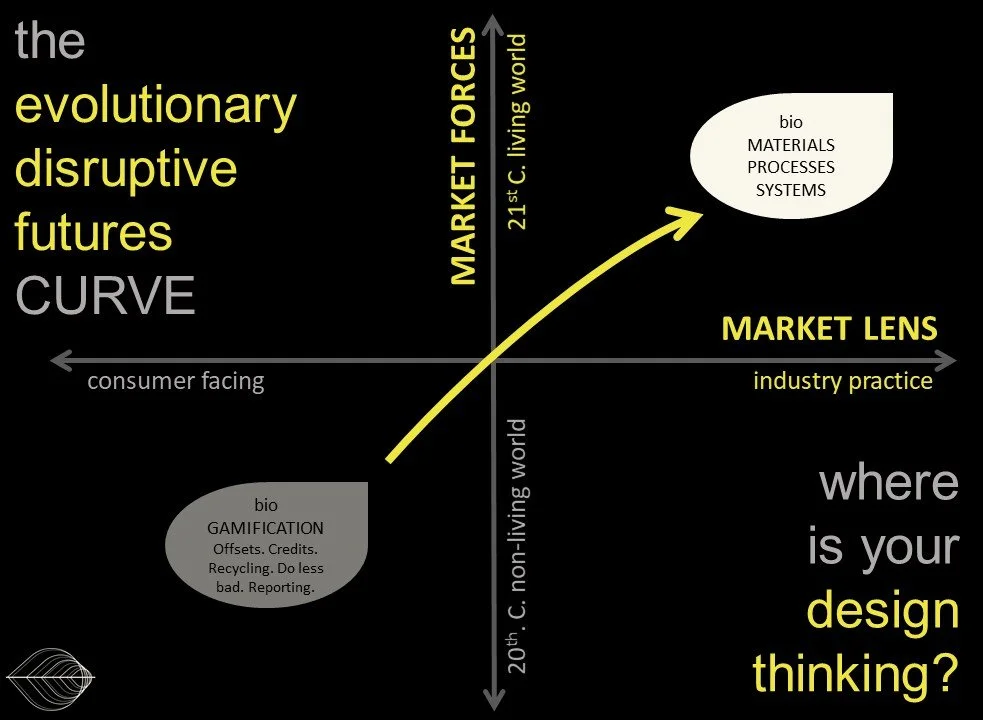
Rhetoric is one thing. Actual business practice is another. Where is your energy going? Where are your BMI frameworks taking you? Where is your strategic advice pushing you towards? The more you answer YES to the following prompts , the more likely you are holding back your potential - and onboarding risk:
Your approach to INNOVATION orbits around "faster, better, cheaper, newer".
Your approach to STRATEGY gravitates to chasing unfair competitive advantage.
Your approach to ADAPTATION is a rinse and repeat of Agile.
Your approach to TRANSFORMATION is digitization (or restructuring lol).
Your conversation about DISRUPTIVE TECH FUTURES is stuck on large language tools.
Your approach to MARKET SIZING is TAM, SAM, SOM x PESTLE forces.
Your approach to NATURE is compliance disclosures, biodiversity credits, or TNFD tick boxes.
Your approach to LEVERAGE (if you’re honest) hinges off a clever blend of extraction, exploitation, data scraping, restricted access, price arbitrage, borrowing, or zero sum plays.
The #1 barrier that stops many people playing the bigger game is the ability to sense, seize, and scale value potential (called “dynamic capabilities”).
In the circular bio economy, value potential plays with a different playbook.
Is it time to update your design thinking practice?